Guided Coding & Guided Learning
TL;DR
Guided Coding is a three-phase methodology - Plan, Implement, Guide - for writing enterprise-grade software with AI coding agents while maintaining full ownership of your codebase. It is a counterpart to Vibe Coding with a heavy focus on planning and reviewing iteratively in collaboration with the coding agent.
- Plan iteratively with the agent and commit the plan to git. Most important question at the end of this phase: "Would you change anything about the plan?" Ask this repeatedly until the plan stabilizes. When the phase ends, the plan is frozen - from then on it is a record of what you decided, not a document you keep editing.
- Implement by handing off a single focused plan to the coding agent in a fresh conversation, backed by automated feedback loops like linting, automated testing, automated benchmarks, etc.
- Guide by thoroughly reviewing all generated code - this is where you spend most of your time. Understand the code, identify issues, and ensure quality. For small issues, prompt the agent to go back to the Implementing Phase. For larger changes, write a follow-up plan together with the agent. Close the record with a Plan Deviations document whenever follow-up plans exist or the finished code materially departs from the accepted plans.
You never stop guiding - it just changes shape along the way. In Planning, you and the agent map out the route together. In Implementing, you step away and let the plan and your feedback loops keep the agent on track. In Guiding, you take the wheel yourself.
Spend rules-file context deliberately, find the right plan size empirically for the LLMs you use, and stay vigilant about important software traits like functional correctness, performance, and security.
Guided Learning is a variant for developers who are still learning the domain a plan touches: in the Implementing Phase, you write the code yourself while the agent teaches you, ideally with a senior developer at your side during Planning and Guiding. See Guided Learning: Getting Started.
A Methodology, Not a Framework
Guided Coding is a way of working, not a toolchain you install. You can adopt all of it with nothing but markdown files, git, and the coding agent you already use. There is no CLI to learn, no artifact format you must conform to, and no vendor to lock yourself into.
That said, I do have a concrete setup that I use every day: a specific plan structure, specific filenames, a specific point at which a plan gets committed, and a set of Agent Skills that automate the mechanical parts. It works well for me, and publishing it saves you from rediscovering the same details. But it is one instantiation of the methodology, not the methodology itself.
So these docs are written in two layers:
- The method - the regular text on every page. This is Guided Coding proper: the reasoning, the constraints, and the things that matter regardless of your language, your tracker, or your agent. If you only read this layer, you have understood Guided Coding.
- The Opinionated Path - set apart in callouts like the one below. This is how I work: exact prompts, exact filenames, and which skill I invoke when. Copy it wholesale, adapt it, or ignore it entirely.
Callouts like this one show my concrete setup. This is the layer the Guided Coding skills encode, and Guided Coding: Getting Started walks through it end to end.
Everything in these callouts is optional. Nothing here is required to practice Guided Coding.
Please don't read "I installed the skills" as "I adopted Guided Coding". The skills automate bookkeeping - writing the draft, freezing it with a timestamp at the right moment, recording deviations. They cannot do the two things the methodology is actually about: thinking hard about the plan, and reviewing every line of code that comes back. Those remain yours.
What Changed in Version 2.0.0
Version 2.0.0 sharpens one idea that was only implicit before: ai-plans/ is an append-only decision record. Plans are not living documents that get edited to match reality. They record what you decided, when you decided it, and - through follow-up plans and Plan Deviations documents - how that decision later changed and why.
- Plans are frozen when their Planning Phase ends: they receive a UTC timestamp and a
*Frozen at ...*line, and get committed. Plan Deviations documents are frozen once committed. The only permitted edit to a frozen plan is ticking an acceptance criterion once the implementation actually satisfies it. - Corrections are made by appending: a follow-up plan supersedes an earlier decision, and the closing Plan Deviations document summarizes follow-ups and any material implementation departures.
- Filenames carry a UTC timestamp, so the directory reads in chronological order regardless of issue numbering.
- The method is distributed as portable Agent Skills and an Agent Plugin at github.com/feO2x/guided-coding.
- Guided Learning joins as a variant for developers who want to learn: two skills let you implement a plan yourself while the agent teaches you, and a private learning profile tracks your progress across sessions. See Guided Learning: Getting Started.
The Plan Record page covers all of this in depth.
Why Not Vibe Coding?
Andrej Karpathy, co-founder of OpenAI, coined the term Vibe Coding in February 2025. The core idea: you tell the coding agent what to do, never go down to the source code level, always click "accept all changes", and the code grows beyond usual comprehension. You only validate by looking at the running app - never at the code itself.
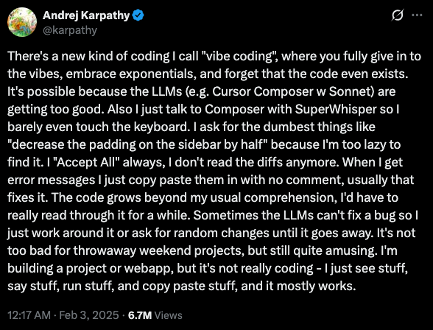
While Vibe Coding is fun for personal projects and useful for rapid prototyping, it is not a viable approach for enterprise-grade software. You have no idea what the code is doing or how it's doing it, and technical debt accumulates quickly. I wanted to formalize a counterpart - a methodology and mental model for working with coding agents that lets you leverage the productivity gains while staying in control of the codebase.
That's what Guided Coding is about.
Where to Go Next
- Want to try the tooling right away? Start with Guided Coding: Getting Started.
- Want to understand the method? Read the Planning, Implementing, and Guiding phases in order.
- Want to know how the plans stack up over time? Read The Plan Record.
- Want to write the code yourself and learn along the way? Read Guided Learning: Getting Started.